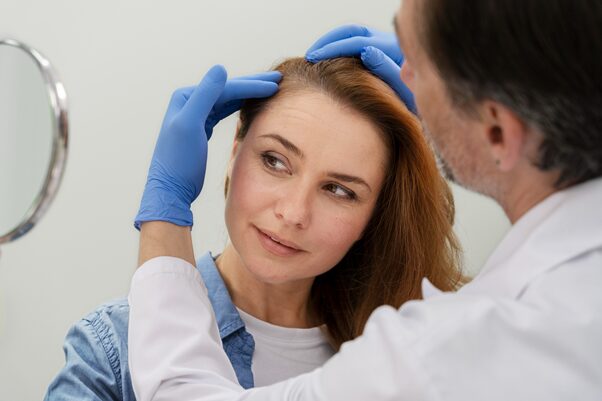
Androgenic alopecia is a common type of hair loss that is prevalent in both men and women. Over the years, different treatment procedures have evolved that help in obtaining quality outcomes.
Androgenic alopecia is a common type of hair loss, which is called female pattern hair loss in case of women. Unlike men, the hair of women gets thinner at the top of the head, whereas the middle part is widened. Leading to total baldness is rare in the case of androgenic alopecia in females.
In Canada, about 40% of women experience some signs of thinning hair by the age of 50. This indicates a significant presence of androgenic alopecia among Canadian women. This blog explores probable treatment options for androgenic alopecia in women. Here is the incidence of female pattern hair loss by age group in Canada.
| Age group | Estimated prevalence |
| 20–29 | 5% |
| 30–39 | 12% |
| 40–49 | 25% |
| 50+ | 40%+ |
Table 1: Prevalence of female pattern hair loss by age group in Canada
Androgenic Alopecia in Females: Top Causes
Hormonal imbalance (DHT sensitivity) is a common cause of androgenic alopecia in women. After menopause, hormone levels in females drop, which affects DHT levels. This causes hair follicles to shrink.
Genetics can be a common cause of androgenic alopecia in women. Like, there is a high chance of occurring female pattern baldness within individuals whose first-degree relatives have hair loss. Medical conditions, like PCOS and adrenal hyperplasia, result in high androgen levels. This results in androgenic alopecia in women. Early diagnosis is important so that the situation does not become worse.
What Are the Main Treatment Options for Androgenic Alopecia in Women?
Androgenic alopecia can be treated by several procedures. Here are the top 7 treatments that are effective for women.
1. Topical Minoxidil (Rogaine)
To treat androgenetic alopecia in females, minoxidil is useful as it stimulates hair growth when applied to the scalp. Here, 2% and 5% solutions are available. Well, the product is also available in foam form.
This treatment option leads to prolonging the hair growth phase. You can see results within 3 to 6 months. Some of the common side effects are scalp irritation, unwanted hair growth, etc.
2. Oral Anti-Androgens
Women suffering from androgenic alopecia can be treated by oral anti-androgens (like spironolactone). This medication helps to lower the androgen level by blocking androgen receptors.
Often, doctors suggest oral anti-androgens to combine with other treatments for better and quicker results. However, this treatment option does not apply to pregnant women. Some of the primary side effects are mood change, menstrual irregularities, breast enlargement, etc. Let’s compare topical and oral treatments for androgenic alopecia.
| Type of treatment | Onset type | Efficiency | Availability in Canada |
| Topical minoxidil | 3 to 6 months | Moderate | OTC |
| Oral spironolactone | 6 to 12 months | Moderate to High | Prescription |
Table 2: Topical vs oral treatments
3. Platelet-Rich Plasma (PRP) Therapy
The platelet-rich plasma therapy is important to treat female pattern hair loss. Here, plasma generated from the patient’s own blood sample is injected into the scalp. This results in the stimulation of hair follicles.
This is a common treatment for androgenic alopecia in women. This involves around 3-4 sessions, and each one costs around $600. Along with preventing hair loss, this treatment process also accounts for promoting new hair growth.
4. Low-Level Laser Therapy
This is a safe and effective procedure for treating androgenic alopecia in women. Here, red light is used for stimulating hair follicles. This results in an increase in hair count. Also, your hair density is improved.
Who is an ideal candidate for low-level laser therapy? Well, women experiencing early to moderate hair loss can be given this treatment. This painless procedure has no downtime. Hence, you can return to regular activities immediately after a session.
5. Hair Transplant Surgery
Hair transplantation is an effective way to treat androgenetic alopecia in females. Referring to this treatment procedure, hair follicles are moved from a donor area to a thinning or balding recipient area. Meanwhile, this is ineffective for diffuse thinning.
FUT and FUE are common procedures. The former one removes a strip of scalp for harvesting follicles, and the latter one extracts follicles individually. This treatment costs around $17,500 in Canada. Recovery time (around a year) can be longer, but you can obtain a permanent result.
6. Low-Androgen Index Birth Control Pills
Birth control pills lower the production of ovarian androgens. Due to this, it is considered to treat androgenetic alopecia in females. In Canada, Diane-35 is common.
Such pills are capable of regulating hormone levels in women with hormonal imbalances. Well, medications must be administered by physicians and are not given without prescriptions.
7. Lifestyle Changes & Nutritional Support
Androgenic alopecia in women can be treated by lifestyle changes and nutritional support. As iron deficiency is a key cause of hair loss in women, iron supplements are effective in treating this disease. This is coupled with proper scalp care and stress management.
A dietary change can help in the treatment of this disease. Well, your diet must contain protein, biotin, and omega-3s. This is not the sole method for treating androgenetic alopecia in females, but it can be used with other treatments.
Selecting the Right Treatment in Canada
Here are some aspects that are to be considered while choosing the right treatment in Canada.
- Acknowledging severity, budget, lifestyle, and medical history
- Consulting a trichologist or dermatologist
- Evaluate customer reviews
Final Thoughts
Androgenic alopecia is a common hair loss issue among women, but it is manageable. Some of the probable treatment options are topical minoxidil, platelet-rich plasma therapy, oral anti-androgens, etc. While choosing the right treatment, you need to assess the budget and severity.